
Swing Speed Chart
Clubhead speed is the biggest single factor in how far you hit the ball. These charts relate driver swing speed to ball speed and approximate distance, suggest a shaft flex range for your speed, and estimate speeds for each club in the bag — useful for fitting, gapping and tracking speed training. The Excel log records sessions from a launch monitor or radar.
- Instant download
- Editable Excel & Word
- Print-ready PDF
- 7-day refund
5 files · PDF, XLSX, DOCX
Swing Speed Chart Pack
Printable driver speed–distance chart, shaft flex guide, club-by-club speed and gapping chart, Excel speed training log and a launch monitor session sheet.
- Speed–distance chart (PDF/XLSX)
- Flex guide (PDF)
- Gapping chart (XLSX)
- + 2 more
$5.00 USD, one-time 5 files · about $1.00 each
- Instant download
- 7-day refund
- Secure checkout by Stripe
7-day money-back guarantee. Full refund within 7 days of purchase, even after you download.
Free sample: Driver Speed Distance Chart (PDF, 61 KB)
Swing Speed Chart Pack
Printable driver speed–distance chart, shaft flex guide, club-by-club speed and gapping chart, Excel speed training log and a launch monitor session sheet.
- Speed–distance chart (PDF/XLSX)
- Flex guide (PDF)
- Gapping chart (XLSX)
- Training log (XLSX)
- Session sheet (PDF/DOCX/XLSX)
Formats: PDF, XLSX, DOCX. Instant download after payment (link valid 72 hours, up to 5 downloads). AI-assisted: the templates were drafted with AI help and reviewed and laid out before publishing.
$5.00 USD, one-time 5 files · about $1.00 each
- Instant download
- 7-day refund
- Secure checkout by Stripe
7-day money-back guarantee. Full refund within 7 days of purchase, even after you download.
Free sample: Driver Speed Distance Chart (PDF, 61 KB)
Full refund within 7 days — see the refund policy and license.
Free printables
Single sheets you can print right now, no sign-up. The full pack adds every sheet in one download plus the editable files.
 Printable Swing Speed Chart
 Printable Swing Speed Flex Guide
 Printable Swing Speed Gapping Chart
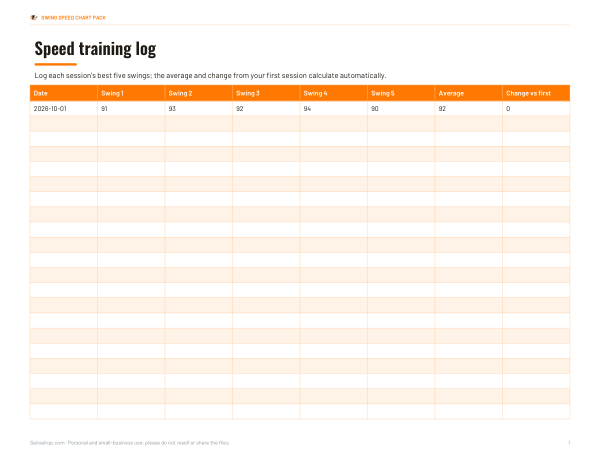 Printable Swing Speed Training Log
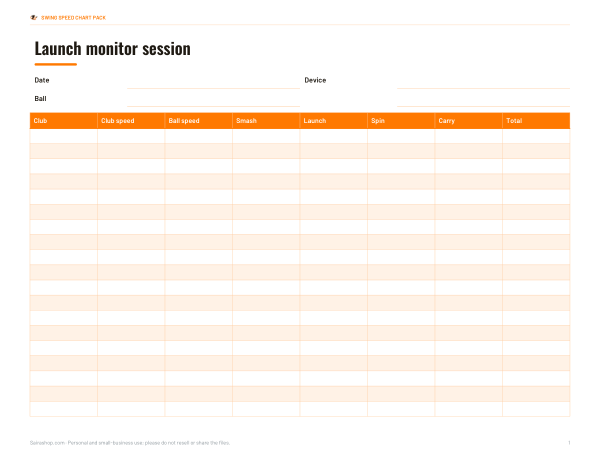 Printable Swing Speed Session Sheet
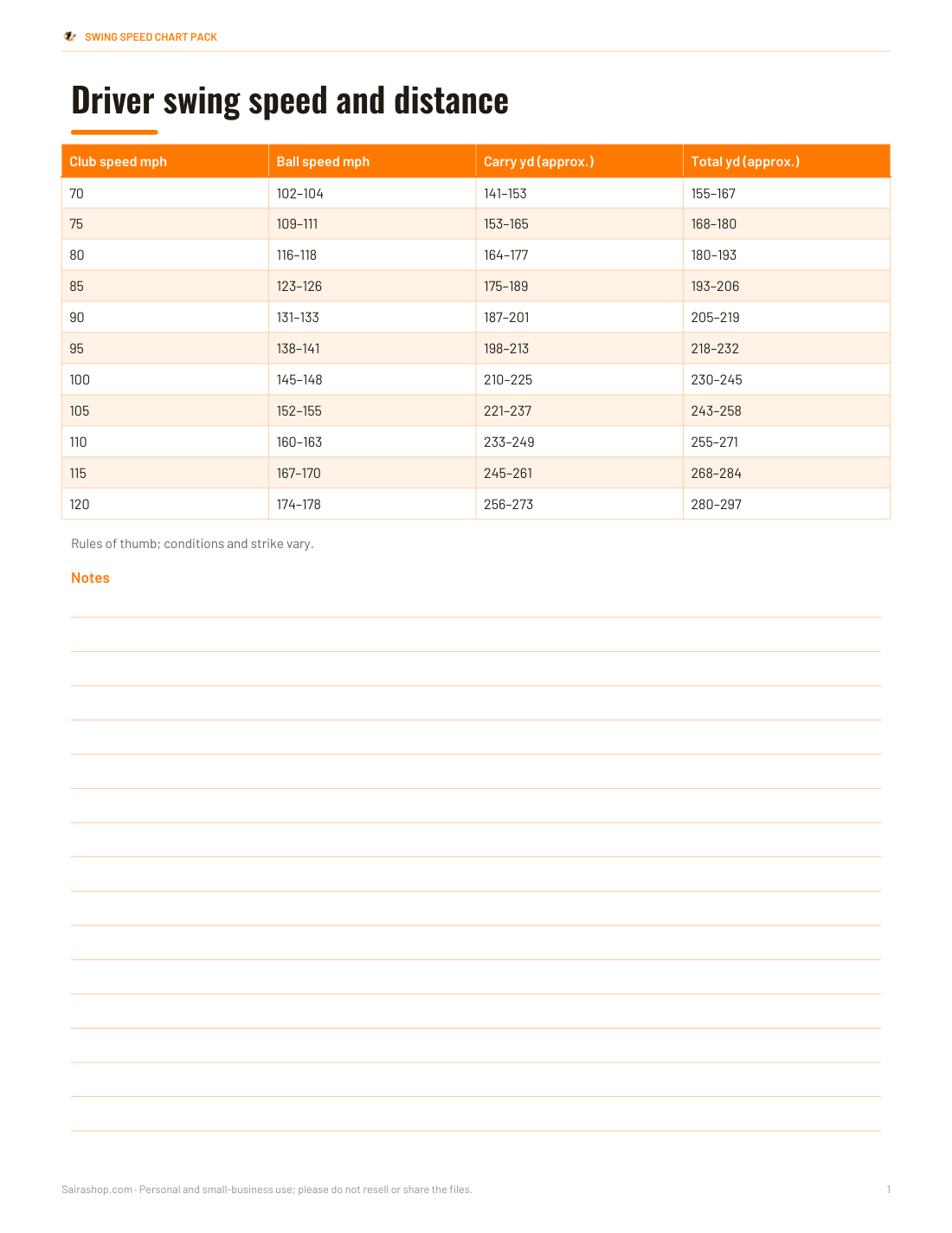
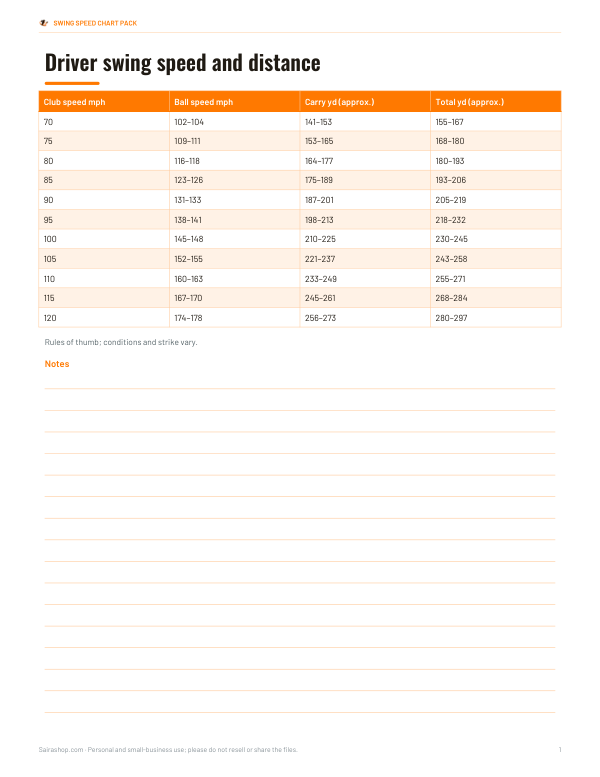
Driver swing speed and distance
| Clubhead speed (mph) | Ball speed at 1.45–1.48 smash (mph) | Approx. carry (yd) | Approx. total (yd) |
|---|---|---|---|
| 70 | 102–104 | 141–153 | 155–167 |
| 75 | 109–111 | 153–165 | 168–180 |
| 80 | 116–118 | 164–177 | 180–193 |
| 85 | 123–126 | 175–189 | 193–206 |
| 90 | 131–133 | 187–201 | 205–219 |
| 95 | 138–141 | 198–213 | 218–232 |
| 100 | 145–148 | 210–225 | 230–245 |
| 105 | 152–155 | 221–237 | 243–258 |
| 110 | 160–163 | 233–249 | 255–271 |
| 115 | 167–170 | 245–261 | 268–284 |
| 120 | 174–178 | 256–273 | 280–297 |
These are rough guides using the common rule of thumb of about 2.3–2.6 yards per mph of driver speed. Real distance depends on strike quality (smash factor), launch angle, spin, ball, temperature, altitude and ground conditions. A centred strike with an efficient launch will beat the chart; off-centre hits fall short.
What smash factor means
Smash factor is ball speed divided by clubhead speed. With a driver, a well-struck shot typically produces a smash factor of about 1.45–1.50 — so 100 mph of club speed becomes about 145–150 mph of ball speed. Irons produce lower smash factors (roughly 1.30–1.40), wedges lower still. Improving strike location can add as much distance as a few extra mph of speed.
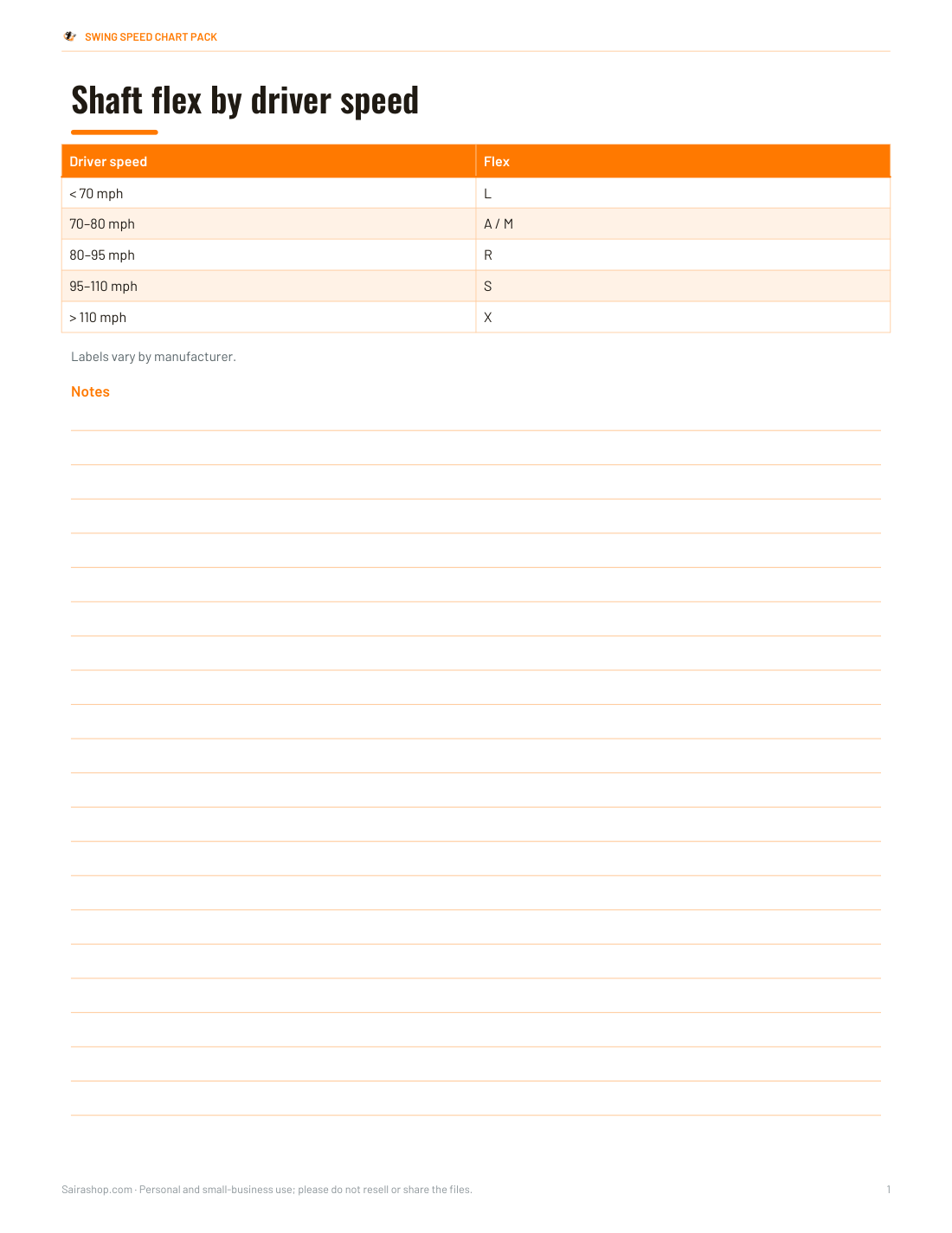
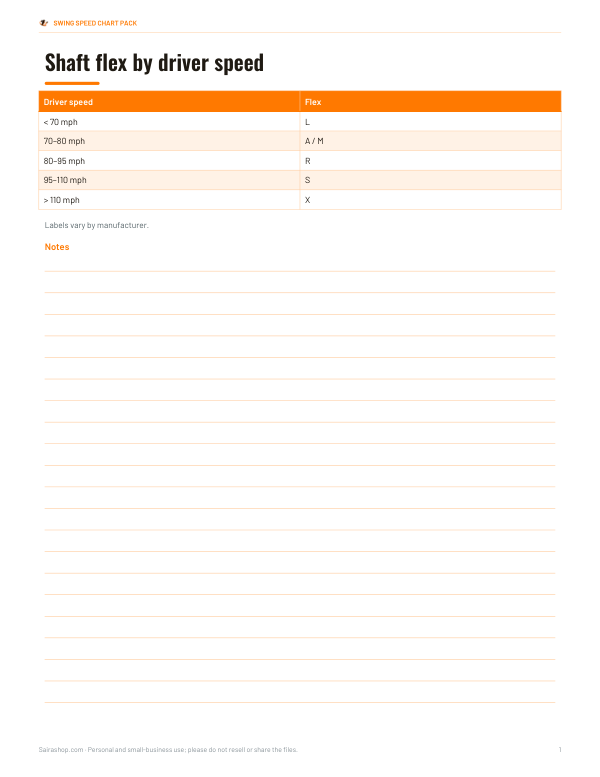
Shaft flex by swing speed
| Driver speed | Common flex | Letter |
|---|---|---|
| Under about 70 mph | Ladies | L |
| About 70–80 mph | Senior / Amateur | A or M |
| About 80–95 mph | Regular | R |
| About 95–110 mph | Stiff | S |
| Over about 110 mph | Extra stiff | X |
Flex labels aren’t standardised — one maker’s regular can be stiffer than another’s — and tempo, transition and release point matter as much as speed. Treat these ranges as a starting point for a fitting, not a prescription.
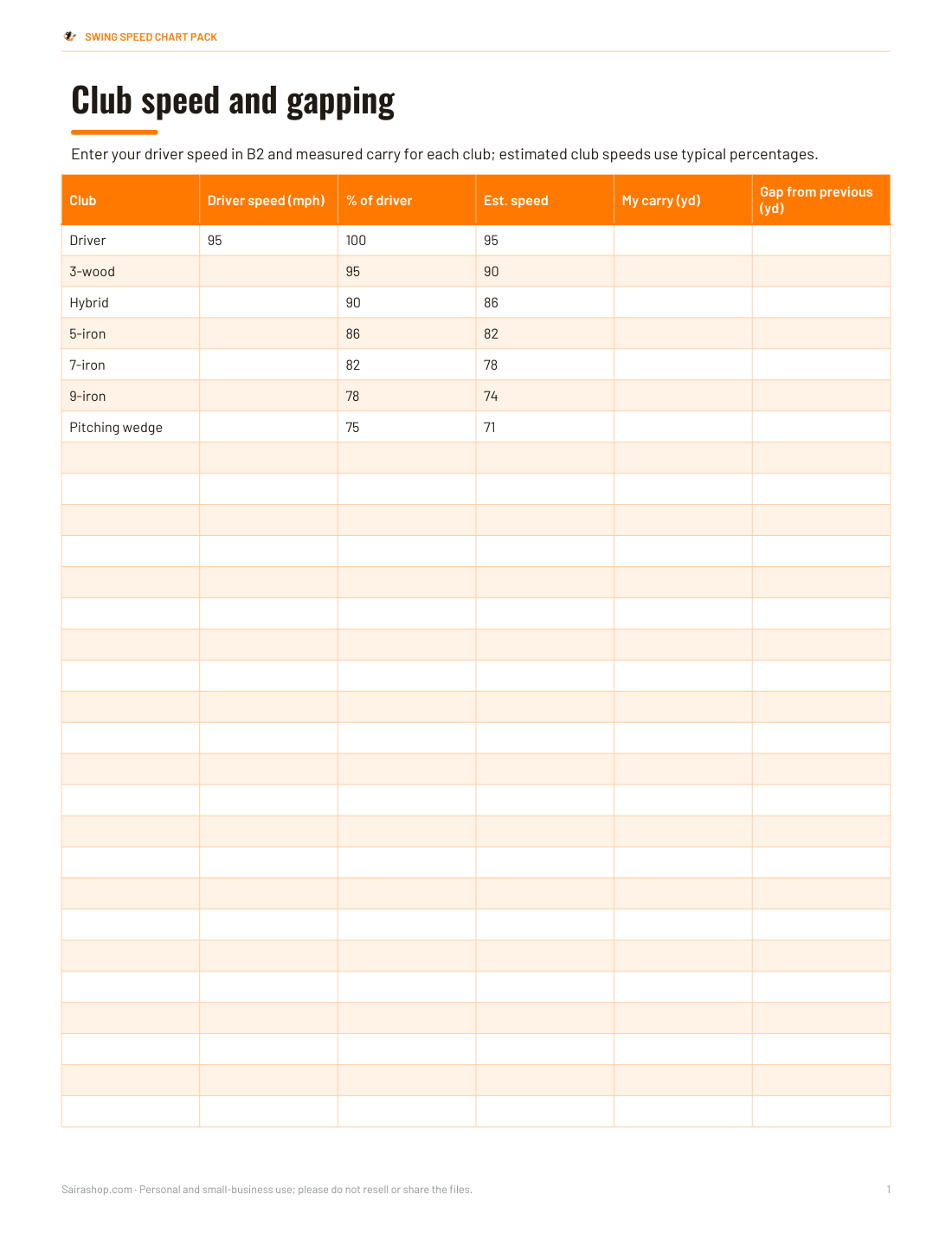
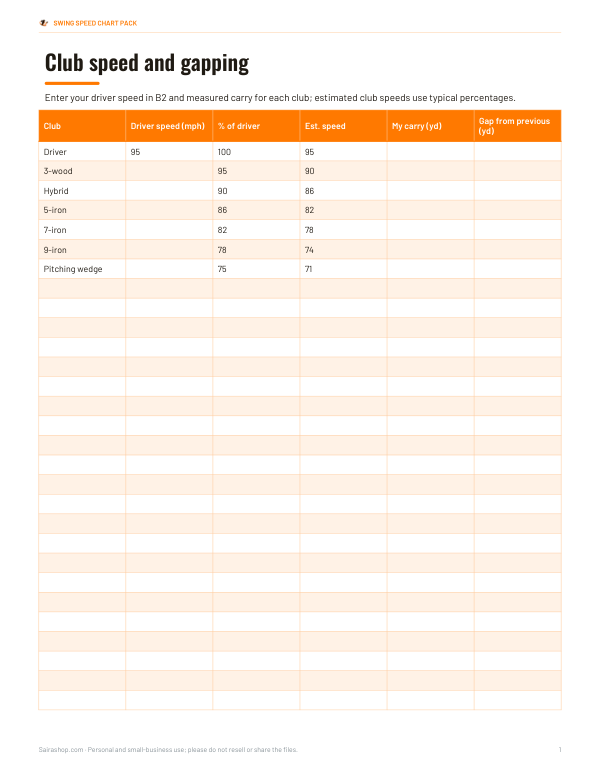
Typical speed through the bag
| Club | % of driver speed (approx.) | At 95 mph driver | At 110 mph driver |
|---|---|---|---|
| Driver | 100% | 95 | 110 |
| 3-wood | 95% | 90 | 105 |
| Hybrid | 90% | 86 | 99 |
| 5-iron | 86% | 82 | 95 |
| 7-iron | 82% | 78 | 90 |
| 9-iron | 78% | 74 | 86 |
| Pitching wedge | 75% | 71 | 83 |
Speeds drop as clubs get shorter and heavier. Launch monitor data from tours and amateurs follows this general pattern; your own gaps may differ, which is why measuring each club is useful for yardage gapping.
How to measure swing speed
- Launch monitors (radar or camera-based) measure clubhead and ball speed, launch and spin — available at fitting studios and many ranges.
- Portable radar devices measure clubhead or ball speed and are popular for speed training.
- Some simulators estimate speed from ball flight.
- Warm up first, take several swings and use the average of your best consistent strikes.
- Note whether a device reports measured or calculated clubhead speed.
Worked example
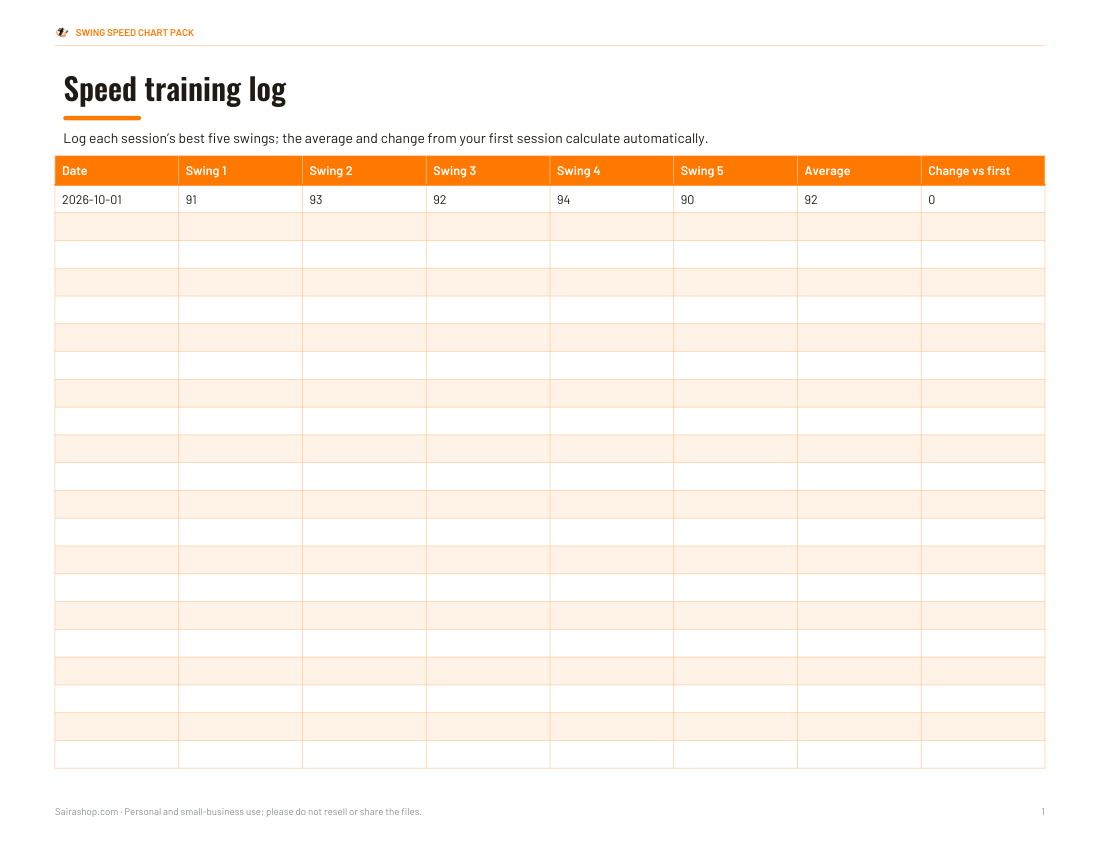
A golfer measures an average driver speed of 92 mph with a smash factor of 1.44, giving about 132 mph of ball speed and a carry of roughly 195–205 yards. The flex chart points to a regular shaft. Over eight weeks of speed training logged in the workbook, their average rises to 97 mph; if strike stays the same, that is about 140 mph ball speed and roughly 12 extra yards of carry — the log’s chart shows the trend week by week.
Getting faster safely
- Speed training programmes typically alternate overspeed (lighter) and overload (heavier) swings in short sessions.
- Warm up thoroughly and stop if you feel pain — the lower back, elbows and wrists are common trouble spots.
- Strength and mobility work in the gym supports speed gains.
- Allow recovery days; speed sessions are high intensity.
- Keep checking strike quality: more speed with poor contact may not add distance.
What’s in the pack
- Printable driver speed–distance chart
- Shaft flex guide card
- Club-by-club speed and gapping chart
- Excel speed training log with averages and a progress column
- Launch monitor session sheet for fittings
All charts print on US Letter and A4; the log opens in Excel and Google Sheets.
AI-assisted content
Charts were drafted with AI assistance and reviewed before publishing. Figures are approximations; a professional fitting with a launch monitor gives the most reliable numbers for you.
Frequently asked questions
How far should I hit a driver at 90 mph?
Roughly 190–200 yards of carry with a good strike, more with roll.
What shaft flex for 95 mph swing speed?
Often regular to stiff — about the boundary; a fitting helps decide.
What is a good driver swing speed?
It varies widely; many amateur men swing somewhere in the 85–100 mph range, and tour professionals considerably faster.
What is smash factor?
Ball speed divided by clubhead speed; about 1.45–1.50 is typical for a well-struck driver.
How much distance does 1 mph add?
Roughly 2–3 yards with a driver, if strike quality stays the same.
Is this a subscription?
No, it is a one-time download.